Introduction of Cold Chain Technologies in Northern Province
- Representative Participant
- SETTSU WAREHOUSE Co., Ltd.
Outline of GHG Mitigation Activity
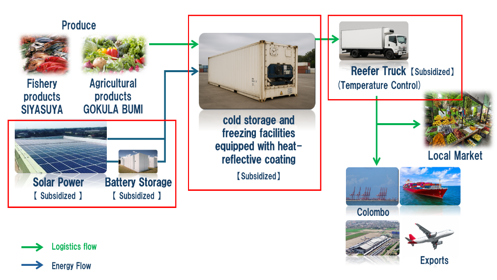
This project aims to establish an integrated cold chain in the Northern Region by introducing refrigerated transport facilities, including energy-efficient refrigerated and frozen trucks, solar power generation facilities equipped with battery storage systems, and high-efficiency refrigerated and frozen facilities coated with heat-reflective paint. This project consumes renewable energy within the own cold chain and a part of electricity generated during daytime is stored in the battery and consumed during evening periods for an efficient use of renewable energy.
By replacing part of the electricity derived from fossil fuels with renewable energy and reducing energy consumption throughout the cold chain, the project will reduce greenhouse gas (GHG) emissions.
Expected GHG Emission Reductions
3,772 tCO2-eq./year
| ①PV+BESS | ②Heat reflective paint | ③Reefer container + Truck |
|---|---|---|
| 1,488 tCO2/year | 236tCO2/year | 2,048tCO2/year |
※Photovoltaic (PV) / Solar Power (PV)、Battery Energy Storage System (BESS)
= Reference CO2 emissions [tCO2/year] − Project CO2 emissions [tCO2/year]
① = (Reference CO2 emissions − 0) × CO2 emission factor
② = (Power consumption calculated for existing equipment − Power consumption calculated with heat-shielding paint) × CO2 emission factor
③ = (Power consumption calculated for existing containers × CO2 emission factor + Fuel consumption × CO2 emission factor of consumed fuel) − (Power consumption calculated for new containers × CO2 emission factor + Fuel consumption × CO2 emission factor of consumed fuel)
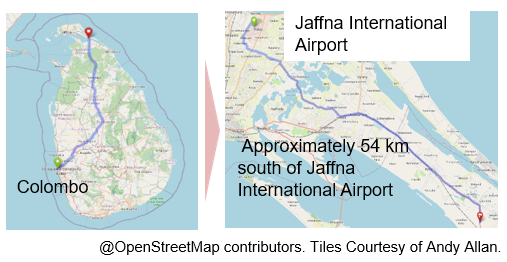
Site of JCM Project